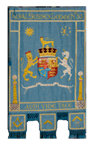
Royal Sussex Lodge No 53
Founded
1812
Regular meetings: the first Monday at 18.30hrs Oct, Nov, Jan, Feb, Mar
Installation: the first Monday at 17.00hrs Dec
Contact the Secretary:
Mike Cotton
Close Window

Previous to the formation of the
“United Grand lodge of England”, in 1813, few Lodges were named as they
are to-day, but were distinguished by a number and place of meeting. It
frequently occurred on a new lodge being formed, instead of it receiving a
number and place in the Grand Lodge register, which it should have done,
it was given the warrant of an older lodge which had lapsed. Thus the
Royal Sussex Lodge, the warrant of which is dated 23rd January,
1812, under the Atholl constitution, received the number of ‘49’ which was
that of a Lodge warranted 30th march, 1756 to meet at the
King’s Head, Drury Lane, London.
The first traceable meeting was held at
the Bladud’s Head Inn, Ladymead in February, 1812; subsequent meetings
being held in a number of other Inns in the City of Bath.
At the numbering of the Lodges in 1814,
the Lodge became No. 69.
December, 1813
To the brethren of the Royal Sussex
Lodge
“The name which I have permitted your Lodge to assume gives it an
additional interest to my solicitude, and therefore requires me expressing
the hope that, as it is the first in this instance, so may I trust that by
your Masonic conduct you will always preserve and maintain the credit of
the same, as an example to all others.
Masonry is the most sublime and perfect institution that ever was formed
for the advancement and happiness and general good to mankind, teaching us
the useful, wise and instructive doctrines upon which alone happiness is
founded, and the duties we owe to our neighbour never to injure him in any
one situation.
Signed by His Royal Highness the Duke
of Sussex, The Grand Master.
April, 1817.
The following entry appears:
“A
letter was observed to be forwarded to His Royal Highness the Duke of
Sussex, returning thanks for the honour he did us in acceding to our
wishes and allowing us to take upon us the title of “Royal Sussex Lodge”.”
May, 1817.
The meeting was at the Greyhound Inn,
at the corner of High Street and Bridge Street, and there the Lodge was to
meet for some years. The brethren about this time were evidently very
enthusiastic, for in the year 1818, nine emergency meetings were held in
addition to the ordinary monthly ones throughout the year, together with
weekly meetings in the months of July and August.
November, 1818.
At the request of a majority of the
brethren then present, the W.M. consented to a private exhibition of
Masonic emblems, and the Lodge room was visited “by about 300 of the
Beauty and Fashion prior to the opening of the Lodge.”
July, 1819.
It will be readily appreciated that the
holding of Lodges in various Inns cannot be altogether satisfactory, and
no doubt this reason prompted the building of the first Masonic Hall in
the City, known as ‘York hall’, now the Friends Meeting House.
The three lodges concerned in the
building of this hall were the Royal Cumberland, the Royal York, and the
Lodge of Virtue. The Royal Sussex Lodge did not directly participate, and
its headquarters remained at the Greyhound Inn.
December, 1820.
The Junior Deacon was fined 1/-d. for
non-attendance.
July, 1826.
Resolved to leave the Greyhound Inn in
consequence of insults received, and to move to the Masonic Hall, York
Street, at a rental of £14. 0. 0. p.a. The first meeting took place in
September 1826.
February, 1827.
Bylaws agreed in open Lodge include:
(i) Meetings to be held at Masonic Hall, York Street.
(ii)
Scales of fines for non attendance of officers.
(iii)
Profound silence to be observed in the Lodge.
(iv)
Stewards to observe the greatest economy concerning refreshments.
(v)
Visitors not to be admitted during private business etc. etc.
March, 1831.
It was resolved that the W.M. should
meet the W.Ms. of Royal Cumberland Lodge, and the Lodge of Honour and
arrange more convenient days of meeting to enable members of different
Lodges to visit each other.
March, 1831.
Due to the York Street Hall being
advertised for sale, it was resolved to move to the White Lion Inn. 7/6d.
to be charged per evening and 7/6d. to be spent on refreshments, including
fire, etc. The first meeting took place in October 1831.
February, 1833.
A letter received from Grand Lodge
changing the number from 69 to 61.
April, 1834.
It was reported that a lease had been
entered into with Mr. Goodridge for the new Masonic Hall in the Corridor,
at a rental of £40.0.0 p.a., which was to be divided as follows:
Royal Cumberland -
£12. 0. 0.
Royal Sussex - £8. 0. 0.
Lodge of Honour - £20. 0. 0.
Each Lodge to pay for its own
consumption of gas.
By 1843, however, the three Lodges had
agreed to pay £10 each.
November, 1854.
Meeting held at the Christopher Hotel.
January, 1855.
First printed Lodge summons issued.
March, 1858.
Two engineers initiated, whose names
were to become well known in the City, namely Mr. Stothert and Mr. Pitt.
March, 1860.
Resolved “that members of Her Majesty’s
Services, or those in the militia or Volunteer Corps attending this Lodge
in uniform be requested to leave their arms in the care of the Tyler in
the ante room”.
January, 1863.
The Lodge notice for the first time
inserted in the minute book; a custom continued since this date.
July, 1863.
UNITED GRAND LODGE OF ANTIENT, FREE AND ACCEPTED MASONS OF ENGLAND
THE
R. HON. THE EARL OF ZETLAND THE MOST WORSHIPFUL GRAND MASTER.
“The G.L. having resolved that the number of all Lodges in the Register
shall be brought forward in regular succession by filling up those numbers
which have become vacant within the voluntary surrender of warrants or by
the erasure of Lodges.
I
have the honour to inform you that your Lodge which has hitherto been
known and distinguished as No. 61 will henceforth stand in the Register of
G.L. as No. 53 and this latter number you are to refer to in all returns
and communications addressed to the G.L.”
By
Order of W.B. Gray Clarke, Grand Secretary,
Freemasons Hall, London.
6th
July, 1863.
Letter from the Grand Secretary that in
renumbering the Lodges, the Royal Sussex would in future be known as No.
53 instead of 61.
January, 1864.
It was resolved to commence a charity
fund to relieve brethren in distress.
Bro. R. Pitt gave an interesting
account of a visit to a Lodge in Berlin, and the fraternal manner in which
he had been received.
October, 1865.
A committee to be appointed to consider
the expediency of seeking fresh accommodation and in November 1865 it was
resolved to build a new hall.
April, 1866.
A number of alternative proposals were
considered but rejected in favour of the purchase of the present building
in Old Orchard Street. The site was originally in the orchard of a
Benedictine Abbey but prior to purchase it was a Roman Catholic Church
but from 1750 to 1805 the first Theatre Royal in the provinces. Where many
famous actors and actresses including Sarah Siddons, graced the boards. .
The premises consisted of a chapel and
two houses, freehold but subject to a ground rent of £47. 3. 0., which
were offered by the vendors for the small sum of £150, but subject to two
conditions, namely:
(i) That the church should be allowed to retain undisturbed possession of the
vaults below, with the right of access thereto
by a separate entrance, and
(ii) That the chapel itself should never be used for the purposes of amusement
and entertainment permitting dancing.
December, 1866.
The new Masonic Hall was consecrated by
Bro. Rev. C.R. Davy, W.M. of the Royal Sussex Lodge, with full Masonic
ceremony. There were forty-nine members and nearly seventy visitors
present. Two brethren were passed to the second degree and two were raised
tot the third degree. After which Bro. William Gibbs was installed
Worshipful Master and Bro. W. Smith was re-elected Treasurer.
It is of interest to note, that the
total expenditure on the hall and adjoining houses, which were at that
time let off, was then £636. 8. 8.
The chief alterations to the chapel
were the removal of the pews, which were used to provide the screens to be
seen on each side in order to lessen the width of the building, and the
portioning off of the space under the gallery at the west end to form an
ante room.
December, 1868.
Bro. Stothert was installed as W.M.
During his year of office the minutes report that the lodge was out of
debt and that the £636. 8. 8. had been fully paid off.
sub-tenancies were offered to:
The Royal Cumberland Lodge No. 41 and
its Royal Arch Chapter.
The Lodge of Honour No. 379
The Bladud Encampment of Knights
Templar. No. 1
February, 1869.
The minutes record a list of gifts from
various brethren to the estimated value of £95, towards the fitting up of
the Lodge.
May, 1870.
The Lodge building fund was first
established, a wise move which was to prove of immense value in later
years.
December, 1883.
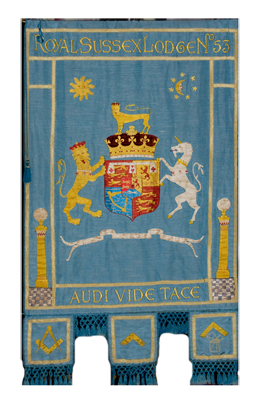
The Lodge banner presented by 21 Past
Masters.
March, 1884.
Bro. Watts suggested it would be
advisable “that the Emulation working should be adopted in the Lodge,
instead of the present working, which is uncertain.” The W.M. agreed, and
said that he understood that the Lodge professed to work by the Emulation.
But even today the brethren appreciate
that small differences which have been accepted for very many years have
become traditional in this Lodge and it is hoped that they will remain so.
January, 1887.
Organ Music could not have been heard
in the ceremonies until Bro. Cuffe Adams presented the Lodge with the
organ he had purchased from the Bath College at the time of its closing.
October, 1869.
Resolved to convey the Masonic Hall to
Trustees for the Royal Sussex and Royal Cumberland Lodge, and subsequently
the Chapel gallery at the west end was removed and the present Dining Room
constructed at a cost of something over £500, which cost was met by the
Lodge building fund, supplemented by special contributions.
In 1891 the reredos panel, which
originally were indifferent representations of Faith, Hope and Charity,
were repainted by John Barker in their present form, representing Solomon,
King of Israel, Hirem, King of Tyre, and Hiram Abiff.
In 1896 the William Hoare painting of
the Pool of Bethesda, which previously hung in the Octagon Chapel, was
presented to the Trustees by Bro. Radway, and it still occupies its place
of honour above the Senior Warden’s chair. In 1904 electric lighting was
installed
In 1908 the Lodge was honoured by the
appointment of R.W. Bro Col Long as the Provincial Grand Master of
Somerset.
In
1912 a Centenary Warrant was issued by Grand Lodge.
In the Great War the Lodge saw 13 of
the brethren enlist in 1914, sadly two failed to return.
The years 1923 and 1925 saw further
alterations and repairs carried out, bringing the building substantially
into its present state. The Caretaker’s quarters were constructed and
secondly the museum and library were established on the upper floors.
The declaration of the Second World War
in 1939 immediately influenced Lodge activities. Meetings were held on
Saturday afternoons and the “supper” cost the sum of five shillings.
On the nights of April 25th
and 26th 1942 enemy planes bombed bath – causing extensive
damage to the Masonic Hall. A lot of valuable glass and china were lost
through blast damage and in the confusion that followed the raids the
Warrant, the Tyler’s Sword, and numerous small items including silver
snuff boxes mysteriously disappeared. Of the missing items only the
Warrant has since been recovered – and that from the coal cellar of all
places.
In order that Lodge meetings could
continue temporary repairs were effected pending the end of the war.
January, 1949.
The Keynsham Temple became our
temporary venue for meetings in order that war damage repairs could be
undertaken. Because of petrol rationing transport was made available – a
coach was organised to leave North parade at 5.45 pm and returned at
approximately 9.30 pm.
The repairs were completed at a cost of
£4,500 15s. 2d. and in 1950 we returned to our old Orchard Street abode.
1956
–
Inauguration of the Annual Ladies Festival – this tradition has been
continued to this day. This encounter was the first since 1818 when we had
the exhibition of regalia.
1957
–
Brought the return of petrol rationing and numerous apologies for lateness
are recorded in minutes of the period.
1958
– It was agree that the Lodge in future would meet 7 times a year instead
of 8. The first Almoner was appointed.
Floods caused the Installation meeting
in December to be postponed.
1968
– The Chaplain, W.Bro. Fred Tranter, marked his 27 Masonic years with the
gift of one firing glass for each of those years.
1972
– Since the war, and the loss of the Tyler’s sword, successive holders of
this office have been frustrated by having to beg or borrow swords from
other Lodges. The Tyler, Bro. J Legg, finally solved the problem by kindly
donating a handsome antique sword, the origin of which was contemporary
with the founding of the Lodge.
1973
– One of our brethren, WB Sidney Smith met a French brother, Jacques
Lycett at the Bristol Aeroplane Co which resulted in the first visit from
Versailles of ‘La Loge La Delta 134. Fraternal visits large and small have
taken place ever since. Often accompanied by brethren of other lodges from
Bath and the surrounding area. The R.Wor. Bro. Kenneth Kinnersley,
Provincial Grand Master for Somerset often accompanied us on these visits.
The visits were subsequently organised by our own Bro Robert James Davies
and Jean Boissiere of the Loge La Delta.
March, 1975.
R.Wor. Bro. Kenneth Kinnersley,
Provincial Grand Master for Somerset was made an honorary member of the
Lodge. In May the Loge La Delta 134 visited again and presented us with a
silver candelabrum.
1976 – Honorary membership was
conferred on The very Worshipful Bro Stanley Humbert and VW Bros His Royal
Highness Prince Alexander of Yugoslavia.
26
April, 1980
The W.M. W.Bro Robert James Davies
organised a meeting of all lodges in the United Grand Lodge of England
bearing the title of Royal Sussex at the Masonic Hall, Old Orchard Street,
Bath. It is believed this was the first time such a meeting has taken
place.
1983
– The United Grand Lodge of England recognised the Royal Sussex Lodge’s
practice of our Stewards wearing red collars.
1986
– The IPM, WM and the SW donated six candelabra to illuminate the after
proceedings at the dining table.
1987,
16th May.
The Lodge banner was restored at a cost
of £300, being fully met by donations of the brethren of the Lodge.
175th
Anniversary of the Lodge
From this necessary short history it
will be seen that like many other Lodges the Royal Sussex has not been
without adversities, especially in its earlier years, but while preserving
a characteristic independence it has been ever ready to face up to the
responsibilities which rightly fall to one of the oldest Lodges in the
Province, and to work in harmonious relationship with the other Craft
Lodges in Bath.
A typical example of this is the Lodge
of Instruction which is run jointly for the proved benefit of the younger
brethren of the Lodge of Honour and the Royal Sussex Lodge. Thereby
maintaining our assurance of 1825 of co-operation in everything tending to
the benefit of Masonry.
Members of the Royal Sussex Lodge are
rightly proud of, and give grateful thanks for the labours of those who
have gone before and made it possible for us to enjoy the undoubted
privilege and the joy of heritage of this wonderful Lodge.
10th
March, 2005
Royal Sussex Lodge hosted the
rededication of Masonic Temple after extensive alterations to the
basement. The ceremony of rededication was presided over by The Provincial
Grand Master RW Bro David L. Jenkins and the rest of the Provincial team.
All the other Lodges in Bath were represented by their Masters, Offices
and Brethren.
Return to top of page
Click here for a link to the Royal Sussex Royal Arch Chapter No.53
|